
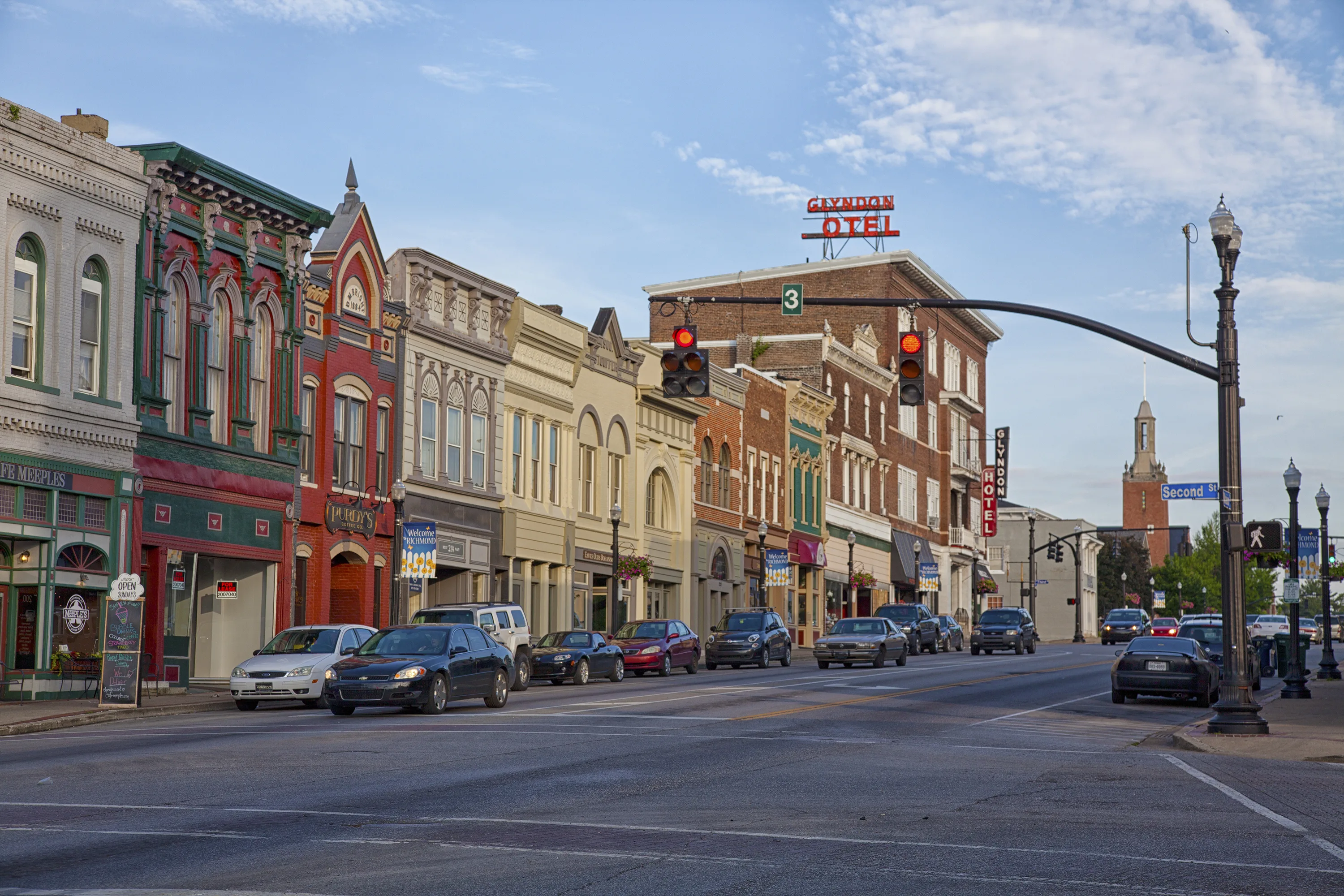
Richmond's event base ties to Eastern Kentucky University, the regional healthcare network, and the surrounding Madison County economy. Programs that book Richmond usually have an EKU, healthcare, or association angle.
The town has its own meeting venues, on-campus options at EKU, and surrounding hotel inventory that handles regional conferences and training programs.
Operationally, Richmond plays as a Lexington spillover or a primary booking depending on the program. Freight and labor come off the Lexington lane; drive-up access is straightforward off I-75.
These pages cover when Richmond belongs in a Bluegrass program, how the university-driven demand shapes the calendar, and what the venue inventory supports.
Richmond location priorities
- Align graphics, AV, and utility requests with the same calendar as the booth work.
- Leave room for storage, reuse, and return freight so the next cycle starts cleanly.
- Give the floor one clear lead so live decisions stay controlled during install and strike.
Richmond — what the area looks like for events
Richmond as an event area: a Madison County university town led by Eastern Kentucky University with healthcare and education-driven event demand.
Richmond sits about 25 minutes south of Lexington off I-75 in Madison County, with EKU's campus and a steady run of education and healthcare employers as the local base.
Richmond's meeting inventory includes EKU campus venues, local hotels along the I-75 corridor, and civic event spaces sized for regional conferences and training.
Operational rules on the Lexington floor
Floor operations for Richmond follow each venue's own manual.
Practical rule: confirm utilities, rigging, and labor in writing before fabrication finishes, not during install.
Lexington venues we work
Most Richmond work in Lexington lands inside a small set of venues, and each one runs on its own published rules.
For Richmond, venue choice changes install sequence and labor calls more than any other single decision. The same booth runs differently at the convention center than at a hotel ballroom.
The Lexington venues that matter most for Richmond: Central Bank Center for full exhibit floors, the downtown host-hotel ring (Hyatt, Hilton, Marriott City Center) for breakouts and overflow, and Griffin Gate for resort-flavored programs.
What drives the Lexington calendar
Outside those windows, the venues run smaller programs.
For Richmond, that pattern matters because dock windows, rigging slots, and labor capacity compress on peak weeks. Booking off-peak opens up the calendar.
For Richmond specifically, picking the right week changes the cost line and the venue options. Peak weeks cost more and offer fewer choices.
Scope in Richmond
Scope on a Lexington program based in Richmond usually carries the same line items as a downtown engagement: structure, graphics, AV, show services, labor, freight, supervision, and strike.
Richmond's meeting inventory includes EKU campus venues, local hotels along the I-75 corridor, and civic event spaces sized for regional conferences and training.
Operationally, programs in Richmond usually file fewer convention-floor orders and more hotel events orders. The cost line shifts toward catering and AV and away from drayage and rigging.
For Richmond-anchored programs, the right scope balances local audience access against what downtown venues offer that suburban and regional venues don't.
The boundary line: organizer fees, client travel, and internal software stay outside the Richmond scope and route through coordination.
What an engagement actually looks like
A Richmond engagement opens with a scope conversation: show, venue, booth number, dates, budget frame. Specifics produce better plans than generalities.
After the brief, focus shifts to the building.
One named show-site lead runs the install.
What it costs and how fast it moves
Every Richmond project shares the same cost drivers.
The levers that matter for Richmond: build path (custom, modular, or rental), footprint, venue service fees, graphics, freight, and supervision days.
On timing for Richmond: Custom: 16 to 20 weeks. Rental: 8 to 12. Under 4 weeks is a rush, with fewer options and a premium on materials.
How project performance gets measured
Performance for Richmond measures across two layers: technical (on-time install, no venue callouts, clean show hours, complete strike) and business (leads, floor-booked meetings, post-show pipeline).
The technical layer is hygiene; the business layer is return. A clean install with no leads is a problem; a messy install with leads is also a problem.
The post-show debrief connects the layers. Which demo station drew traffic, which meeting area closed conversations, which graphic zone earned dwell time, all of that feedback shapes the next Richmond build.
How we're built to run your project
Trade Show Services of Lexington runs Richmond as a local team. In-house design, fabrication, graphics, and show-site crews share one shop, one point of contact, one accountable lead per project.
The second Richmond install runs faster than the first; the third runs on memory.
Richmond location questions
Do you work at Central Bank Center?
Yes.
How does labor work in Lexington?
It runs venue by venue.
How much lead time is ideal?
Custom builds run best with 16 to 20 weeks of lead time. Rentals take 8 to 12 weeks.
What information kicks off a project?
The show, the venue, the booth number, the dates, and a target budget range. From those, an initial scope and a realistic cost come back within a few days.
Who runs the booth on-site?
One named show-site lead runs the install, the show hours, and the strike. That person carries the floor plan and the punch list from crates to doors and reports up once a day.
Can the booth travel to the next city on our calendar?
Same structure, swappable graphics, standard crates.
What happens if something breaks during show hours?
The on-site lead handles it.